
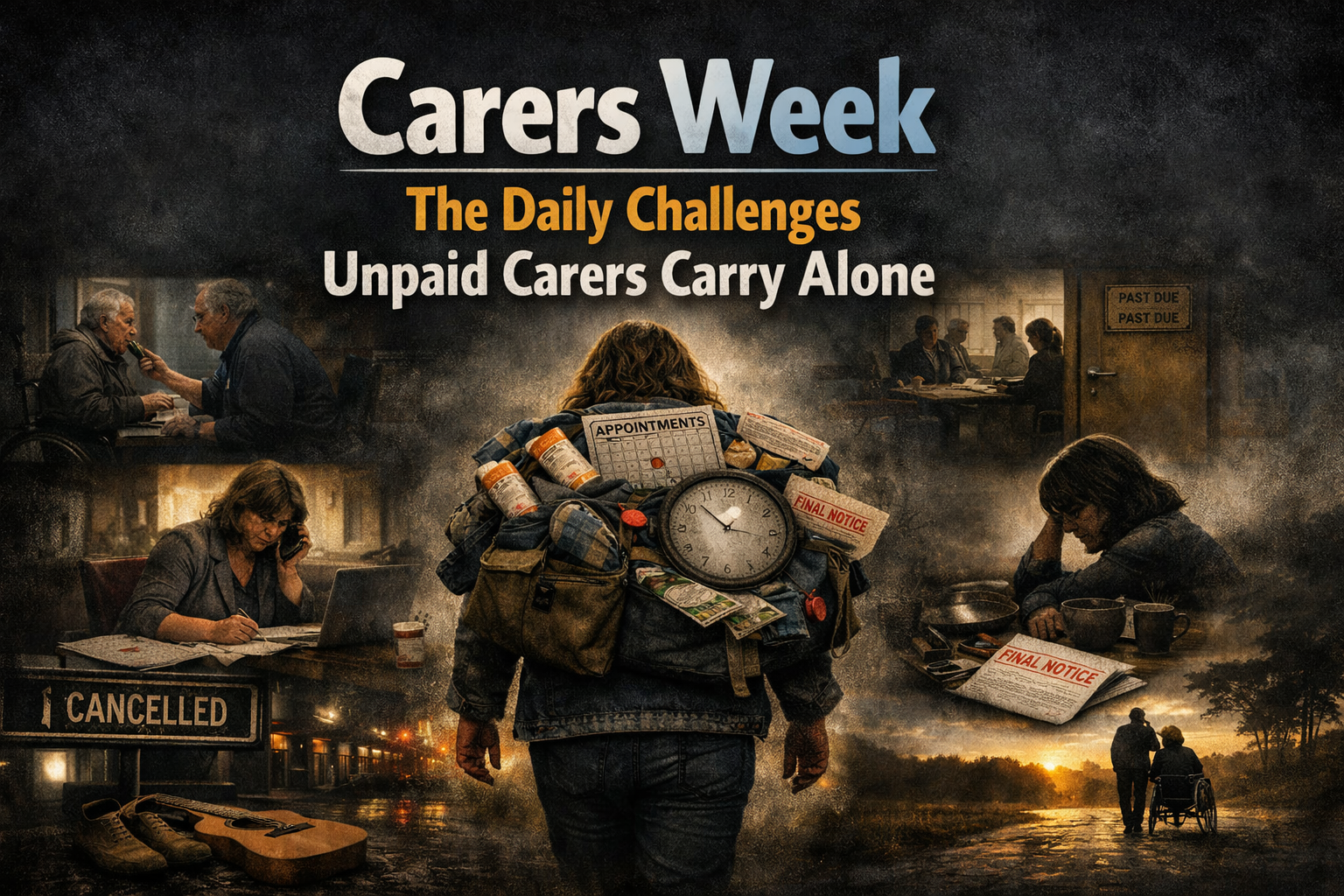
Carers Week: The Daily Challenges Unpaid Carers Carry Alone
Every day across Wales and the UK, unpaid carers hold together the lives of the people they love and, by extension, the health and social care system that depends on them.
Yet the challenges they face are so often invisible, minimised, or dismissed as “just what families do”.
Carers Week is a moment to make those hidden realities visible.
Not for sympathy, but for change.
The Weight of a Day: What Caring Really Looks Like
For most unpaid carers, there is no such thing as a “typical day”.
There is only the next task, the next crisis, the next phone call, the next form, the next hour of holding everything together.
Below are the daily challenges carers face, not occasionally, not during a crisis, but every single day.
1. The Time Pressure That Never Lets Up
Caring doesn’t fit neatly into mornings, evenings, or weekends. It expands to fill every gap.
- Medication schedules
- Personal care
- Mobility support
- Supervision
- Night‑time monitoring
- Emergency appointments
Many carers provide 35+ hours a week, and thousands provide round‑the‑clock care.
There is no clocking off. No guaranteed rest. No predictable routine.
Time pressure is one of the biggest drivers of burnout, yet it remains one of the least recognised.
2. The Financial Strain That Quietly Breaks People
Caring is love.
But love shouldn’t cost your financial security.
Carers lose income, career progression, pension contributions, and stability.
Carer’s Allowance, just £86.45 a week doesn’t come close to covering the real cost of caring.
Daily financial challenges include:
- Reduced working hours or leaving work entirely
- Paying for transport, equipment, or adaptations
- Higher household bills
- Constant trade‑offs between essentials
Financial strain isn’t a side issue. It’s a structural failure.
3. The Health Impacts Nobody Sees
Unpaid carers experience higher rates of anxiety, depression, chronic illness, and exhaustion.
Not because caring is harmful, but because support is missing.
Daily health impacts include:
- Lifting and physical strain
- Sleep disruption
- Hypervigilance
- No time for their own medical appointments
- Emotional exhaustion from constant responsibility
Carers are told to “look after themselves”, but self‑care is impossible without system‑level support.
4. The Battle With Complex, Fragmented Systems
Caring isn’t just caring.
It’s navigating healthcare, social care, benefits, education, housing, and transport systems, often all at once.
Daily system challenges include:
- Repeating the same information to multiple agencies
- Long waits for assessments
- Inconsistent respite
- Confusing or contradictory advice
- Being passed from service to service
Carers don’t need more resilience.
They need a system that works.
5. The Isolation That Creeps In Quietly
Caring can shrink a person’s world until it’s just them and the person they support.
Daily experiences of isolation include:
- Losing friendships
- Missing community events
- Feeling invisible
- Losing identity outside the caring role
- Days without adult conversation
Carers often say they feel “forgotten”.
And too often, they are.
6. The Emotional Load No One Talks About
Caring is emotionally complex.
It’s love, fear, guilt, pride, grief, frustration, hope, and responsibility all at once.
Daily emotional challenges include:
- Worrying about the future
- Feeling responsible for everything
- Advocating constantly
- Managing crises alone
- Carrying guilt for not doing “enough”
This emotional labour is real work, but it’s rarely acknowledged.
7. The Lack of Recognition That Cuts Deep
Carers keep the system afloat, yet too often they are:
- Overlooked by professionals
- Excluded from decisions
- Treated as an afterthought
- Expected to cope without support
Recognition isn’t about praise.
It’s about rights, respect, and being taken seriously.
Why Carers Week Matters
Carers Week isn’t a celebration.
It’s a spotlight - a chance to say:
“We see you. We hear you. And you shouldn’t have to do this alone.”
Unpaid carers deserve:
- Proper financial support
- Timely assessments
- Consistent respite
- Joined‑up services
- Recognition as partners in care
- Policies shaped by lived experience
Carers Week is one week.
Caring is every week.88